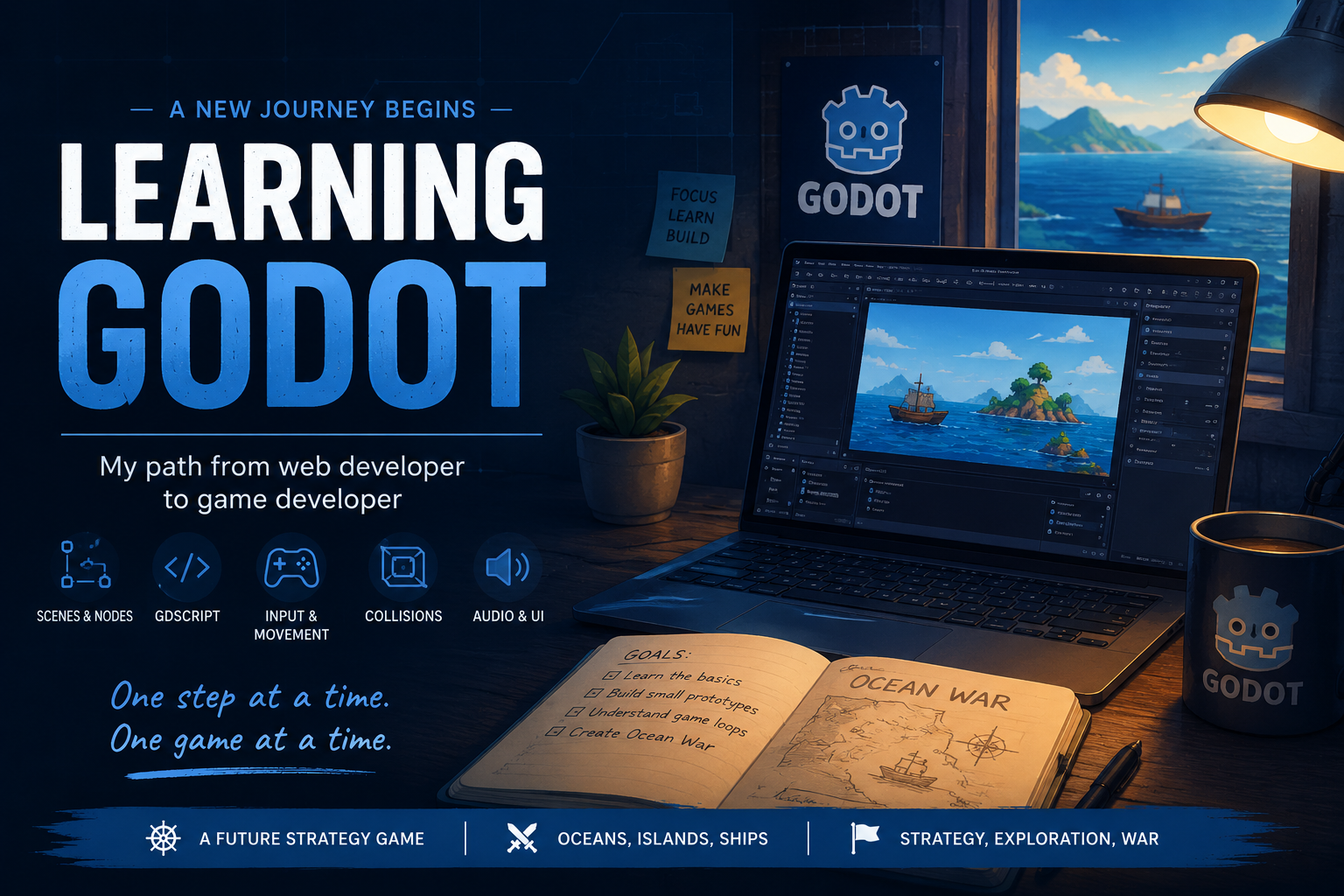
Learning Godot: Starting a New Journey in Game Development
I have spent most of my development career building websites and web applications. I am comfortable working with frontend frameworks, backend systems, databases, APIs, and the usual challenges that come with web development.
Game development, however, is still a different world for me.
Recently, I decided to start learning Godot, an open-source game engine that can be used to create games for desktop, mobile, and other platforms. This is the beginning of a new learning journey, and I want to document the process as I slowly understand how game development works.
Why I Chose Godot
One of the main reasons I became interested in Godot is its simplicity.
Compared to some larger game engines, Godot feels approachable for someone who is just getting started. The editor is lightweight, the project structure is understandable, and its main scripting language, GDScript, looks familiar to developers who have worked with languages such as Python or JavaScript.
Godot also supports both 2D and 3D game development. Since I am still exploring what kind of game I want to build, having both options available gives me room to experiment.
Another important reason is that Godot is free and open source. I can learn, build prototypes, and potentially release a game without worrying about engine subscription costs or royalties.
Starting From the Beginning
At this stage, I am not trying to build a complete game immediately.
My first goal is to understand the fundamentals of the engine.
That includes learning how Godot organizes a project, how scenes and nodes work, how scripts are attached to objects, and how different parts of a game communicate with each other.
Coming from web development, I naturally try to compare these concepts with the tools I already know.
A Godot scene sometimes feels similar to a reusable component. Nodes can be compared to smaller elements inside that component, each with its own responsibility. Signals remind me of events, while scripts contain the logic that controls behavior.
The concepts are not exactly the same, but finding these similarities makes the learning process less intimidating.
Learning GDScript
GDScript is another important part of my journey.
The syntax looks relatively clean and easy to read. Variables, functions, conditions, loops, and classes are familiar concepts, so I am not starting completely from zero.
The bigger challenge is not the programming language itself. It is learning how programming works inside a game engine.
In web development, most actions are triggered by user input, API responses, page events, or scheduled processes. In game development, I also need to think about frames, physics updates, collisions, animations, movement, input handling, and game state.
Understanding when and where certain code should run will probably take time.
My First Learning Goals
For now, I plan to focus on small and manageable exercises.
I want to learn how to:
- Create and organize scenes
- Add and configure nodes
- Move a character using keyboard input
- Detect collisions
- Use signals
- Display menus and user interfaces
- Switch between scenes
- Save and load simple game data
- Add basic sound effects and music
- Export a project for desktop and mobile
Instead of watching tutorials without building anything, I want to create small prototypes after learning each concept.
Even a simple character moving around an empty map can teach me about input, animation, physics, collisions, and camera behavior.
A Future Game Idea
One of the reasons I am learning Godot is because I want to explore a future game project currently called Ocean War.
The name is not final, and the game concept is still evolving. At the moment, I imagine it as a strategy game involving oceans, islands, ships, exploration, resources, and naval conflict.
There are still many questions that I need to answer.
Will it be a real-time strategy game or turn-based? Will the player control individual ships or manage an entire fleet? Will the game focus more on combat, trading, exploration, or territory management?
I do not need to finalize all of those decisions yet.
Before building a large game, I first need to understand the engine and discover what is realistic for me to create. Small prototypes will help me test ideas before committing to a full production plan.
The Advantage of Being a Web Developer
Although game development is new to me, my experience as a web developer still gives me a useful foundation.
I already understand programming logic, debugging, source control, project organization, databases, servers, and user interface development. These skills will not automatically make game development easy, but they should help me learn more efficiently.
I also know from experience that large projects are built through many small improvements.
A complete game may look overwhelming, but it can be divided into smaller systems: movement, combat, inventory, maps, user interfaces, saving, networking, and many others.
The goal is to learn one system at a time.
Challenges I Expect
I know there will be difficult parts along the way.
Art, animation, music, sound design, game balance, physics, and performance optimization are areas that are very different from my normal web development work.
There is also the challenge of avoiding an overly ambitious first project.
As developers, it is easy to imagine a large game with dozens of systems before we have even created a working character controller. I want to stay aware of that and keep my early projects small.
My first Godot project does not need to be impressive. It only needs to help me learn.
Documenting the Process
I want this blog to serve as a record of my progress.
I plan to write about the things I learn, the mistakes I make, the problems I encounter, and the solutions I discover. This will help me remember important lessons and may also help other developers who are starting their own Godot journey.
Some entries may cover technical topics, while others may focus on game design decisions, experiments, or development challenges.
I am still at the beginning, so there is a lot that I do not know yet.
That is also what makes this journey exciting.
Moving Forward
My next step is simple: install Godot, become familiar with the editor, and create my first small project.
I am not expecting to build Ocean War immediately. For now, I want to understand the tools, develop good habits, and slowly improve my game development skills.
Every finished scene, working script, solved bug, and completed prototype will be one step forward.
This is the beginning of my journey into Godot and game development.
Let us see where it goes.
Comments
No comments yet.